
Commercial Kitchen Gas Systems in Saudi Arabia
Restaurants · Hotels · Central Kitchens
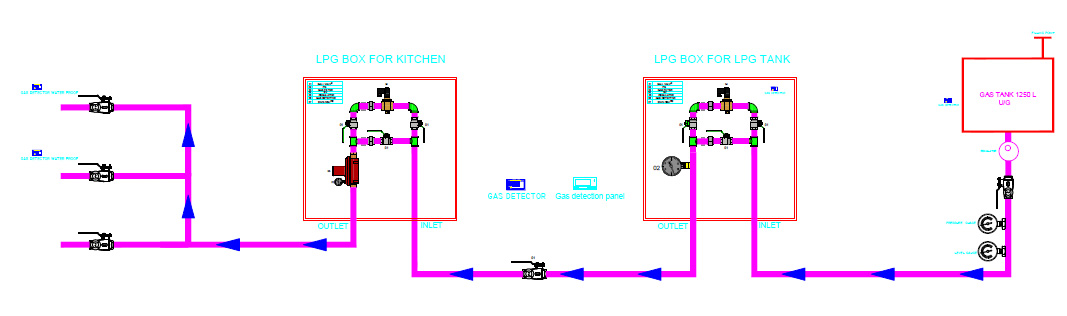
A central LPG network sized for commercial kitchen loads: a tank or cylinder bank outside the building, two-stage pressure regulation, pipework to every appliance, and leak detection interlocked with an emergency shut-off valve. We serve restaurants, hotels, central kitchens, banqueting venues, bakeries and institutional facilities.
Kitchen gas system scope
From the gas source outside the building to the connection point of every appliance.
Gas source
- Above-ground or underground LPG tank
- Cylinder bank for smaller loads
- Safe location outside the building
- Vaporizer for higher loads
- Tank valves and accessories
- Securing and labelling of the gas area
Pressure regulation & pipework
- First-stage regulator at the source
- Second-stage regulator before the kitchen
- Steel or copper pipework per design
- Flexible stainless hoses for movable appliances
- Isolation valve at every appliance
- Consumption meter where required
Detection & emergency shut-off
- LPG leak detectors inside the kitchen
- Control and alarm panel
- Solenoid valve for automatic shut-off
- Emergency stop button at kitchen exits
- Siren and strobe
- Shut-off interlocked with the alarm system
Handover & documentation
- Network pressure test
- Leak test before operation
- Appliance operating pressure setting
- Detector calibration
- Kitchen team briefing on emergency shut-off
- Drawings and handover documents
How the network is sized
- 01Appliance schedule: ranges, fryers, ovens, steamers, grills.
- 02Manufacturer-declared energy consumption for each appliance.
- 03Simultaneity factor based on kitchen type and peak hours.
- 04Pipe runs and fitting count for pressure-drop calculation.
- 05Required operating pressure at every appliance.
- 06Tank capacity matched to the intended refill cycle.
Kitchen safety requirements
Delivery stages
Survey → Design → Supply → Install → Test → Maintain
- 01Survey & Assessment
- 02Engineering Design
- 03Supply
- 04Installation
- 05Testing & Commissioning
- 06Operation & Maintenance
Who we serve
Engineering guides
What Is a Central Gas System?
An overview of the LPG Central Gas System — from tank to appliances — and why it replaces scattered cylinders.
Central Gas for Villas
How a central gas system is designed for a villa: tank location, internal pipework, detection and emergency shut-off.
LPG Systems for Restaurants & Kitchens
What a commercial kitchen gas system needs: simultaneous load, ventilation, detection and shut-off, and day-to-day usability.
Kitchen gas FAQs
How does central kitchen gas differ from cylinders inside the kitchen?
A central system keeps the gas storage outside the building and delivers regulated gas through fixed pipework to every appliance instead of moving cylinders through the kitchen — reducing handling risk and providing a single emergency shut-off.
What tank capacity suits a restaurant?
Capacity follows the total appliance consumption, the simultaneity factor and the intended refill cycle, so we always start from an appliance schedule before recommending a size.
Does the system include leak detection and automatic shut-off?
Yes. The kitchen can be fitted with leak detectors, an alarm panel, a solenoid valve and an emergency stop so supply is isolated automatically on detection, according to the design and facility requirements.
How long does a kitchen gas installation take?
It depends on appliance count, pipe runs and site readiness. Scheduling starts after the survey and design approval, followed by installation, testing and commissioning.
Do you provide maintenance after commissioning?
Yes — leak checks, regulator and valve inspection, detector calibration and emergency shut-off testing under a scheduled programme.
Service areas
We deliver commercial kitchen gas projects for facilities across the regions of Saudi Arabia.
Have a project or an existing facility that needs an engineering review?
Our engineering team can review your requirement and propose a solution suited to the application, the site and the applicable requirements.